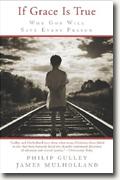
Here are some thoughts I have written after reading “If Grace is True” and “If God is Love” by Philip Gulley and James Mulholland.
I think Phillip Gulley has a kind heart and a clouded mind. Philip Gulley is a nice guy with a great sense of humor who has written some wonderful books-but he stopped. He didn’t stop writing well and he didn’t stop getting books published. While the quality of his writing as continued, perhaps even improved, his theology has become corrupted in dangerous ways.
He has become of victim of his own affable spirit. Apparently he has been unable to reconcile in his mind and in his theological construct the clear statements of the Bible about eternal judgment. He still quotes the Bible and has a degree of reverence and respect for it but he has openly denied its factual reliability. He denies the reality of hell though he still cherishes hopes of heaven for all. He doubts the deity of Jesus and the effect of his death though he still has regard for the ethic that Jesus embodies to him.
This is a simple denial of sound, orthodox understanding of the Bible message. It is a departure or denial of historic Christianity. He has embraced universalism. His theology is expressed in a readable and anecdotal style but it is a serious and subtle attack on sound thinking about the message of salvation. If Philip Gulley is wrong, there is a great deal to be lost in embracing his views, as warm and compelling as they are. They are a restatement of some of the basic ideas of classical theological liberalism. This is interesting because classical liberalism is now a bit anachronistic as it has been displaced by post-modernism and syncretism and, they tell me that even as I am just beginning to get a grip on post-modernism it is going out of fashion.
Trusted people who know about these things are saying that on the buffet of ideas post-modernism is being whisked away and it is being replaced by other entrees for our metaphysical taste buds. Food poisoning is still deadly, even when it when it disguises itself with fancy intellectual-sounding names.
Ideas are even more deadly when they disguise themselves in the homespuns of warm middle-American virtue. That’s what Philip Gulley has done.
There are two big problems with Mr. Gulley’s lastest writings you can see one by looking back and the other by looking forward. If you look back you will see this is not the historic Christian faith. If you dare to look forward you will see that the fruit of this belief will not produce holy-living or genuine love Mr. Gulley wants to foster.
Denying depravity will not insulate us from its effects. Classical liberalism has lowered the standards of holiness and morality and ethics but it is powerless to produce the miracle of a new heart and a new life in people. And it is powerless to deliver people from judgment of which Jesus frequently warned people. How can we justify taking from the pages of the Bible only the things that warm our hearts and rejecting things that warn us of danger. How can we revere only a part of the Bible and reject another part? How can we be devout cynics?



Recent Comments